
Our Blog
DWI vs DUI: What Is the Difference in Minnesota?

If you have recently been arrested for drunk driving, you probably have countless questions running through your mind. As you read through your police report and court documents, you might see different acronyms being used. Some people say they got a “DUI,” while others say they were charged with a “DWI.” Consequently, you might wonder exactly about the debate between DWI vs DUI in Minnesota. Are these two separate crimes? Is one penalty more severe than the other?
At the Wolfgram Law Firm, our criminal defense attorneys frequently hear these questions from confused clients. Therefore, we want to provide complete clarity. Below, we break down exactly how Minnesota law treats these terms, what the statutes actually say, and what it means for your specific criminal case.
The Short Answer: There Is No Legal Difference in Minnesota
Let us clear up the confusion immediately. In the state of Minnesota, there is absolutely no legal difference between a DUI and a DWI. In fact, if you search through the official Minnesota Statutes, you will quickly discover that the state legislature does not formally use the term “DUI” at all.
Under Minnesota Statute Chapter 169A, the only legally recognized term is DWI (Driving While Impaired). When people talk about getting a “DUI” in Minnesota, they are simply using a colloquial phrase that they have heard on television or in movies. Therefore, whether someone calls it a DUI or a DWI, they are referring to the exact same criminal charge under Minnesota law.
What Does DUI Stand For?
The acronym DUI stands for Driving Under the Influence. This term became incredibly popular nationwide decades ago. Furthermore, many other states—such as California and Florida—still officially use DUI as the actual legal charge in their state statutes.
Because the term “DUI” is used so heavily in national news and pop culture, many Minnesota police officers, judges, and even lawyers will occasionally use the word in everyday conversation. However, if a police officer hands you a ticket that says “DUI,” the formal criminal complaint filed by the prosecutor will always read “Driving While Impaired.”
What Does DWI Stand For?
The acronym DWI stands for Driving While Impaired. Minnesota lawmakers intentionally chose this specific term because it covers a much broader range of illegal behavior than simply drinking alcohol.
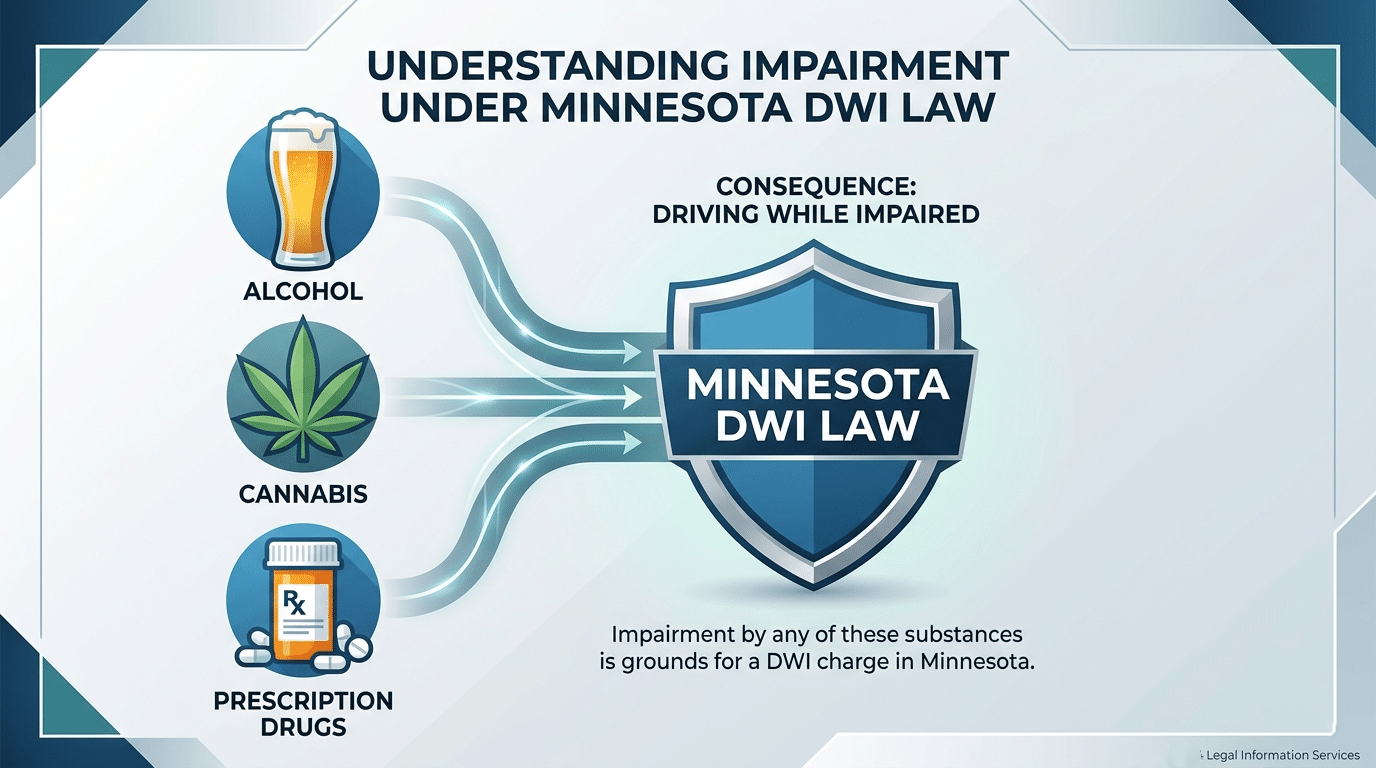
By using the word “impaired,” the state makes it crystal clear that you can be arrested for far more than just failing a breathalyzer. Specifically, Minnesota law states that you can be charged with a DWI if you operate a motor vehicle under the influence of:
- Alcohol: Having an alcohol concentration of 0.08 or more within two hours of driving.
- Controlled Substances: Any amount of a Schedule I or II controlled substance (such as cocaine, methamphetamine, or heroin) in your body.
- Cannabis: Driving under the influence of cannabis products, even though recreational marijuana is now broadly legal in the state.
- Prescription Medications: Driving while impaired by legally prescribed drugs, if those drugs make you unsafe to operate a vehicle.
Penalties for a Minnesota DWI
Because DUI and DWI are the same crime in Minnesota, the penalties are entirely dependent on the specific facts of your case, rather than the name of the charge. Minnesota divides DWI charges into four distinct degrees of severity.
The severity of your charge depends entirely on the presence of “aggravating factors.” These factors include having prior DWI convictions within the last ten years, blowing a 0.16 or higher on a breath test, or having a child under the age of 16 in the vehicle. A standard first-time offense without any aggravating factors is a Fourth-Degree DWI, which is a misdemeanor. Conversely, if you accumulate three aggravating factors, you will face a First-Degree DWI, which is a felony offense.
Why You Need a Criminal Defense Attorney

Regardless of whether the arresting officer called it a DUI or a DWI, the legal consequences are incredibly severe. A conviction will result in a permanent criminal record, heavy fines, skyrocketing insurance premiums, and the potential loss of your driving privileges.
Therefore, you must seek experienced legal representation immediately. At the Wolfgram Law Firm, our attorneys know exactly how to challenge the state’s evidence. We meticulously investigate the legality of the traffic stop, the accuracy of the chemical tests, and the procedures followed by the police. Do not face the complex criminal justice system alone. Contact us today for a free, completely confidential consultation.
Frequently Asked Questions
Can I be charged with a DWI if I was just smoking marijuana?
Yes, absolutely. Under Minnesota law, it is illegal to drive a motor vehicle while impaired by cannabis or cannabis products. Even though recreational marijuana is now legal for adult use in Minnesota, driving while under its influence will result in a standard Driving While Impaired (DWI) charge.
Why did the police officer write DUI on my traffic ticket if Minnesota only has DWI?
Police officers frequently use the term “DUI” as a shorthand habit because the term is so universally understood. However, the exact wording on the handwritten ticket does not strictly dictate your criminal charges. When the prosecutor formally files the criminal complaint in court, the official paperwork will cite the state statute for “Driving While Impaired” (DWI).
Is a DWI penalty worse than a DUI penalty?
No. Because Minnesota does not legally differentiate between a DUI and a DWI, there is no difference in the penalties. Your potential jail time, fines, and license revocation periods are based entirely on your Blood Alcohol Concentration (BAC) level and whether you have prior offenses on your driving record.
Our Reviews

Client
Testimonials
 Wolfgram Law Firm Criminal Defense

Canadian Pacific Plaza, 120 South 6th St Unit 2305, Minneapolis
-
Adam and his team here are outstanding and 100% will go the extra mile always staying in great communication.


Our Location
Canadian Pacific Plaza, 120 South 6th Street, Suite 2305, Minneapolis, Minnesota 55402, United States


Call Us
612-584-3675 Hours: 9am - 5pm | Monday - Friday