
Our Blog
Can You Go to Jail for a First DWI in Minnesota?


The moment handcuffs click around your wrists during a drunk driving arrest, sheer panic sets in. As you sit in the back of the squad car, a single, terrifying question dominates your thoughts: can you go to jail for a first DWI in Minnesota? The short, legal answer is yes—jail time is entirely possible. However, the practical reality of what happens in a courtroom is often very different from the maximum penalties listed in the statute.
Whether you actually serve time behind bars depends heavily on the specific facts of your arrest, your Blood Alcohol Concentration (BAC), and the aggressiveness of your legal defense. At the Wolfgram Law Firm, our criminal defense attorneys have kept thousands of first-time offenders out of jail. Below, we break down exactly when a first-time DWI triggers jail time, what aggravating factors prosecutors look for, and how a skilled lawyer fights to protect your freedom.
Standard Fourth-Degree DWI: The Baseline Penalties
A standard first-time drunk driving offense in Minnesota is classified as a Fourth-Degree DWI. This assumes there are no “aggravating factors” present during your arrest. A standard offense means your BAC was under 0.16, you cooperated with the official breathalyzer test at the station, and there were no children inside the vehicle.
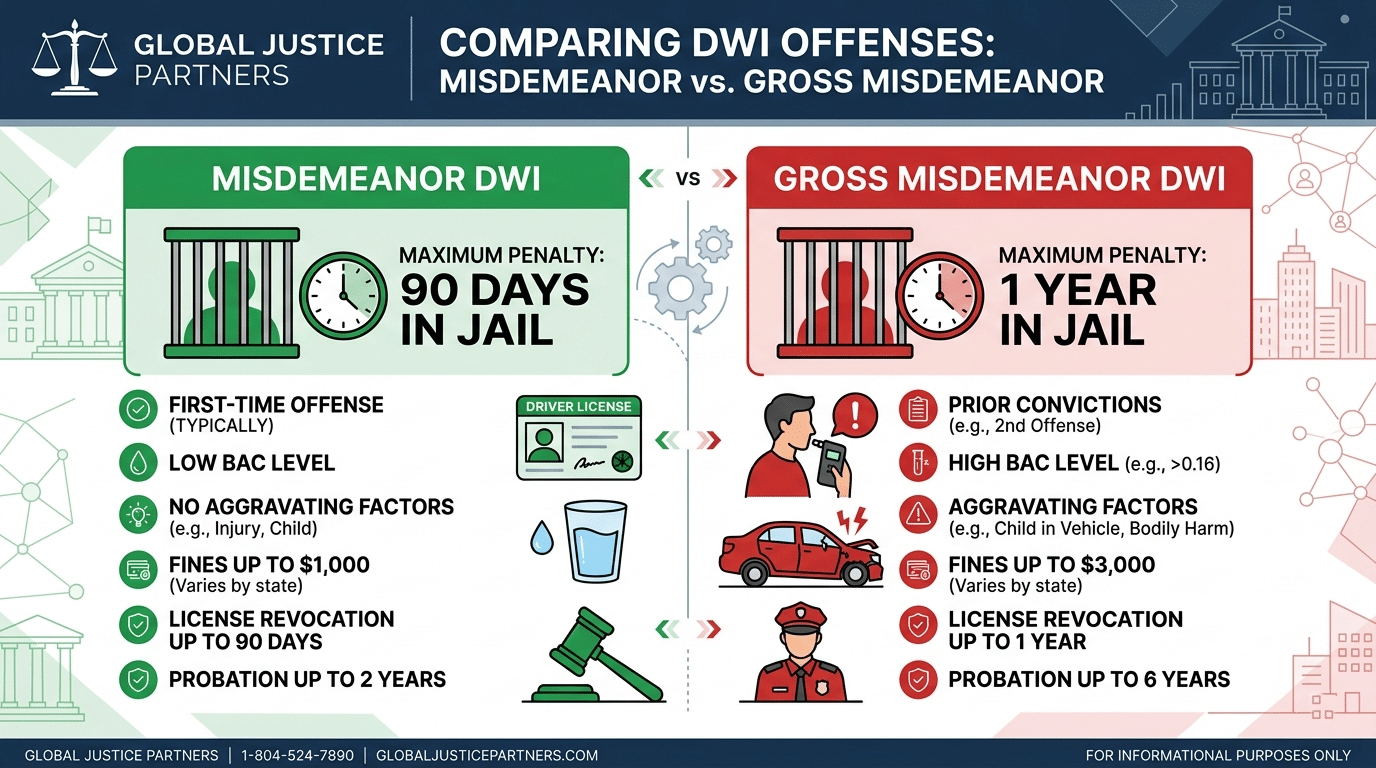
Under Minnesota law, a Fourth-Degree DWI is a Misdemeanor. The maximum statutory penalty for a Misdemeanor is up to 90 days in jail and a $1,000 fine. Because that 90-day number is printed on official documents, many people assume they will be locked up for three months. Fortunately, this is rarely the case.
For a standard, first-time offense, judges almost never impose actual jail time. Instead, they typically issue a “stayed sentence.” This means the judge hangs the threat of jail over your head but allows you to serve your time on probation. As long as you pay your fines, complete a chemical dependency evaluation, and attend a MADD Victim Impact Panel, you can entirely avoid the inside of a jail cell.

Aggravating Factors That Increase the Risk of Jail
The situation changes drastically if your arrest involves “aggravating factors.” These factors elevate a standard Misdemeanor to a Gross Misdemeanor (Third-Degree or Second-Degree DWI), which dramatically increases the likelihood of spending time behind bars.
The most common aggravating factors for a first-time offender include:
- A High BAC (0.16 or higher): If your blood alcohol level is double the legal limit, prosecutors treat the case with extreme severity.
- Child Endangerment: Having a passenger under the age of 16 in your vehicle automatically enhances the charge.
- Test Refusal: Refusing to take the official evidentiary breath, blood, or urine test at the police station is a separate Gross Misdemeanor crime that courts punish heavily.
If you are charged with a Gross Misdemeanor first-time DWI, the maximum penalty jumps to one year in jail and a $3,000 fine. While a skilled attorney can still often negotiate probation instead of a lengthy jail sentence, the prosecutor will fight much harder to impose some form of confinement or strict monitoring, such as Electronic Home Monitoring (EHM) or a SCRAM alcohol-monitoring bracelet.
The Night of the Arrest vs. A Jail Sentence
It is important to distinguish between spending the night in jail after your arrest and actually being sentenced to jail by a judge. Even for a standard first-time DWI, police usually book you into the county jail immediately after the traffic stop. Depending on how busy the jail is, you might sit in a holding cell for a few hours until you sober up, or you might have to spend the night waiting to see a judge to have bail set.
Spending this initial time in custody is terrifying, but it does not mean you have been “sentenced” to jail. It is simply the administrative holding process. Once you post bail or are released on your own recognizance, you are free to go home and begin fighting your case.
Probation Violations: A One-Way Ticket to Jail
The most common reason first-time offenders end up in jail is not because of the original sentence, but because they violate their probation. If a judge grants you a stayed sentence, they will lay out strict conditions you must follow.
Common probation conditions include remaining completely law-abiding, submitting to random alcohol or drug testing, and completing all mandated educational classes. If you drink alcohol while prohibited, miss a scheduled test, or get arrested for another crime, your probation officer will report you to the court. The judge can then revoke your probation and execute your original 90-day jail sentence immediately.
How a Criminal Defense Lawyer Keeps You Out of Jail
You should never walk into a courtroom unrepresented, hoping the judge will go easy on you just because it is your first offense. Prosecutors are aggressive, and they do not have your best interests in mind. To stay out of jail, you need a proactive defense strategy.
An experienced defense attorney will immediately attack the prosecution’s evidence. We scrutinize the legality of the initial traffic stop and investigate the calibration of the breathalyzer machine. If the police violated your constitutional rights, we file motions to suppress the evidence, which often forces the prosecutor to dismiss the case entirely. Furthermore, we aggressively negotiate with prosecutors to reduce your charge to Careless Driving, effectively removing the DWI stigma and the threat of jail altogether.
Take Immediate Action to Protect Your Freedom

The anxiety of facing potential jail time is overwhelming, but you do not have to endure this process alone. A first-time DWI is highly defensible. By taking immediate action, you maximize your chances of securing a favorable outcome.
At the Wolfgram Law Firm, our dedicated team has decades of experience fighting Minnesota DWI charges. We know how the local courts operate, and we know exactly how to negotiate with local prosecutors to keep our clients out of jail and on the road. Contact us immediately for a free, no-obligation consultation. Let us build an impenetrable defense to protect your freedom, your job, and your peace of mind.
Frequently Asked Questions
What is the minimum jail time for a first DWI in Minnesota?
For a standard Fourth-Degree Misdemeanor DWI without any aggravating factors, there is no mandatory minimum jail sentence. Most first-time offenders receive a stayed sentence and serve probation instead of spending any actual time in a jail facility.
Will I lose my job if I get a first-time DWI?
Minnesota is an “at-will” employment state, meaning an employer can fire you for a DWI. However, staying out of jail is the best way to keep your job, as it prevents prolonged absences from work. A lawyer can also help you secure a work permit to ensure you can commute.
Can a first-time DWI be dropped to Careless Driving?
Yes. A skilled defense attorney can often negotiate a plea bargain that reduces a first-time DWI charge to Careless Driving. This typically happens when the defense exposes weaknesses in the state’s evidence, such as an illegal traffic stop or flawed chemical testing procedures.
Our Reviews

Client
Testimonials
 Wolfgram Law Firm Criminal Defense

Canadian Pacific Plaza, 120 South 6th St Unit 2305, Minneapolis
-
Adam and his team here are outstanding and 100% will go the extra mile always staying in great communication.


Our Location
Canadian Pacific Plaza, 120 South 6th Street, Suite 2305, Minneapolis, Minnesota 55402, United States


Call Us
612-584-3675 Hours: 9am - 5pm | Monday - Friday