
Our Blog
What Rights Do You Have After a Criminal Arrest in Minnesota?


An arrest is one of the most terrifying, disorienting experiences a person can endure. In the chaotic moments when handcuffs are placed on your wrists and you are placed in the back of a squad car, it is easy to panic. Police officers are highly trained to exploit that panic to gather evidence against you. To protect yourself and your future, it is absolutely critical that you understand exactly what rights you have after a criminal arrest in Minnesota.
From the moment you are detained, the clock starts ticking. Knowing how to exercise your constitutional rights can mean the difference between a dismissed case and a lengthy prison sentence. The legal team at Wolfgram Law Firm has protected thousands of Minnesotans. Below, we outline the fundamental rights you must invoke immediately upon arrest.
1. The Right to Remain Silent (The 5th Amendment)
The Fifth Amendment to the U.S. Constitution guarantees that you cannot be compelled to be a witness against yourself. This is arguably your most powerful shield during a police encounter.
When you are arrested, law enforcement officers will often attempt to strike up a friendly conversation or aggressively demand answers. They may say things like, “If you just explain what happened, we can clear this up and let you go.” Do not fall for this tactic.
Your absolute best response is to state clearly and firmly: “I am exercising my right to remain silent, and I will not answer any questions without my attorney present.” After you say this, stop talking. Do not try to defend your actions, and do not lie to the police, as lying can result in separate criminal charges.
2. The Right to an Attorney (The 6th Amendment)
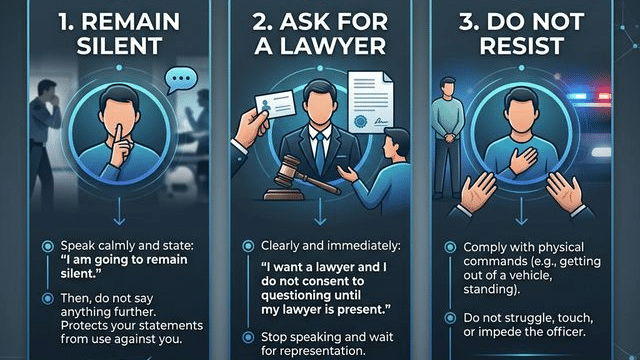
Hand-in-hand with your right to silence is your right to legal counsel. Once you explicitly request a lawyer, law enforcement is legally obligated to immediately stop all questioning. However, this right is not automatic; you must verbally invoke it. Simply staying quiet is not enough.
Furthermore, you have the right to challenge any ongoing interrogation. If the police violate your rights by continuing to question you after you have asked for a criminal defense lawyer, your attorney can later file a motion to suppress, ensuring that any statements you made are thrown out of court and barred from being used against you.
3. Miranda Rights in Minnesota: Timing Matters
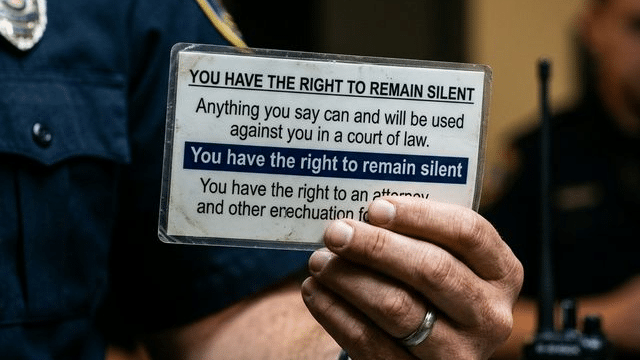
Many people believe that if the police fail to read them their Miranda rights immediately upon arrest, the entire case must be thrown out. This is a common myth popularized by television shows.
Under Minnesota law, police are only required to read you the Miranda warning (“You have the right to remain silent…”) if two specific conditions are met simultaneously: you are in police custody (meaning you do not feel free to leave), AND you are being interrogated. If an officer arrests you for drug offenses but does not ask you any questions while driving you to the jail, they do not need to read you your Miranda rights at that moment.
4. The Minnesota “36-Hour Rule” and the Right to Release
When you are arrested and taken to a local county jail, the state cannot hold you indefinitely. You have a fundamental right to either be formally charged with a crime or released from custody.
Minnesota utilizes the 36-Hour Rule. Once you are booked into jail, the prosecutor has 36 hours to formally file charges against you. If they fail to file charges within that timeframe, the jail is required to release you pending further investigation.
However, the calculation of these 36 hours can be deceiving. The clock begins ticking at midnight following your arrest, and it does not include Sundays or legal holidays. For example, if you are arrested on a Friday night, the 36-hour clock does not even begin until midnight on Saturday, and Sunday does not count. This means you could potentially sit in jail until Tuesday afternoon before charges are filed.
5. The Right to Reasonable Bail
If the prosecutor formally files charges, your next constitutional protection is the right to a bail hearing. In Minnesota, the judge must set bail at a reasonable amount based on the severity of the crime and your ties to the community, or they may release you on your own recognizance (ROR) with specific conditions, such as random drug testing or no-contact orders (which is very common in domestic assault cases).
Your defense attorney plays a crucial role at this hearing, presenting mitigating factors to the judge to lower your bail amount and help you secure your freedom while fighting the case.
What to Do When the Handcuffs Go On

If you are placed under arrest, your adrenaline will spike. Remember the three golden rules: Do not resist the physical arrest (even if you are completely innocent, resisting can lead to felony charges), invoke your right to remain silent, and demand to speak to your attorney immediately.
Your rights mean very little if you do not have an aggressive legal team to enforce them. At the Wolfgram Law Firm, our attorneys respond decisively to protect our clients from unlawful interrogations, unconstitutional searches, and excessive bail. If you or a loved one has been arrested in Minnesota, time is of the essence. Contact us immediately for a free, confidential consultation, and let us start building your defense today.
Our Reviews

Client
Testimonials
 Wolfgram Law Firm Criminal Defense

Canadian Pacific Plaza, 120 South 6th St UNIT 2305, Minneapolis
-
They are truly the **best law firm ever**. From the moment I reached out, I was impressed by their professionalism and dedication. Every member of their team is **highly skilled** and knowledgeable, ensuring that I received the best possible guidance throughout my case.
What stood out the most was their commitment to achieving **the best outcomes** for their clients. They took the time to explain every step of the process, making me feel confident and well-informed. I am nothing but happy with my … More decision to choose this law firm.
If you’re looking for a **high-quality legal team** that truly cares about their clients, look no further than Wolfgram Law Firm. Thank you for everything you’ve done for me!


Our Location
Canadian Pacific Plaza, 120 South 6th Street, Suite 2305, Minneapolis, Minnesota 55402, United States


Call Us
612-584-3675 Hours: 9am - 5pm | Monday - Friday