
Our Blog
How Long Does a Criminal Case Take in Minnesota?


If you or a loved one are facing criminal charges, the uncertainty is often the hardest part to endure. Waiting for court dates, wondering if you will go to jail, and living in legal limbo can cause extreme emotional and financial strain. Clients at the Wolfgram Law Firm frequently ask during their initial consultation: “How long does a criminal case take in Minnesota?”
The truth is, there is no one-size-fits-all answer. A simple misdemeanor might be resolved in a single afternoon, while a complex felony trial can drag on for more than a year. However, Minnesota has very specific legal timelines that dictate how fast the government must move. Below is a detailed breakdown of the Minnesota criminal court timeline, from the moment of arrest to the final verdict.
1. The Immediate Aftermath: 36 and 48-Hour Rules
If you are arrested and taken into custody, the clock starts ticking immediately. The protections afforded by the state and federal constitutions ensure that the police cannot hold you in a jail cell indefinitely without formally charging you with a crime or allowing you to see a judge.
- The 36-Hour Rule: If you are arrested, prosecutors must officially file criminal charges against you within 36 hours. However, the day of the arrest does not count, nor do Sundays or legal holidays. If charges are not filed within this timeframe, you must be released.
- The 48-Hour Rule: Whether you are charged or not, a judge must review the evidence (determine “probable cause”) within 48 hours of your arrest. Unlike the 36-hour rule, this 48-hour clock — includes weekends and holidays.
2. The First Appearance (Arraignment)
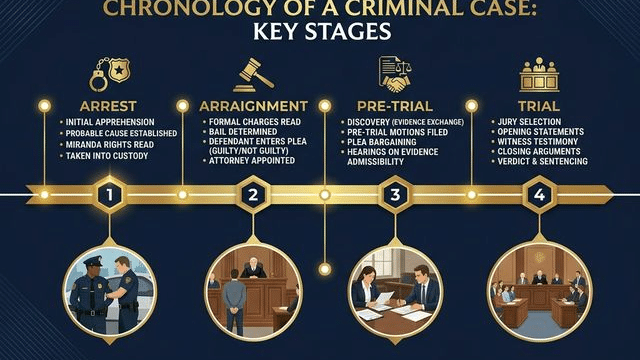
Your first time in front of a judge is called an Arraignment or First Appearance. If you are in custody, this usually happens within a few days of your arrest. If you bonded out of jail or received a summons in the mail, your first appearance might be scheduled 2 to 6 weeks down the road.
At this hearing, the judge will read the charges against you, set your bail conditions, and ask you to enter an initial plea. You should almost never plead guilty at your first appearance without consulting a criminal defense attorney. Pleading “Not Guilty” simply buys your attorney the time needed to review the police reports, body camera footage, and evidence against you.
3. The Pre-Trial Phase (2 to 6 Months)
This is where the bulk of a criminal case takes place, and it is usually the longest phase. During the pre-trial phase, your attorney will engage in “Discovery”–the formal process of obtaining all the evidence the state plans to use against you.
You may also attend an Omnibus Hearing (or Florence Hearing). At this hearing, your attorney can file Motions to Suppress illegally obtained evidence or argue that the case should be dismissed due to a lack of probable cause. Depending on court backlogs and how quickly the state’s crime lab processes evidence (like DNA or narcotics testing), the pre-trial phase can last anywhere from a few months to over half a year.
Why Delay is Often the Best Strategy

Many clients complain that their case is taking too long. However, in criminal defense, time is often on your side. As months pass, police officers forget details, civilian witnesses move away or lose interest, and prosecutors face increasing pressure to clear their massive caseloads. An experienced defense attorney uses this delay strategically to negotiate highly favorable plea deals or domestic assault dismissals.
4. The Speedy Trial Demand (60 Days)
If you want to force the issue, Minnesota law allows you to assert your constitutional right to a “Speedy Trial.” Once your attorney files a formal speedy trial demand, the court is required to start your jury trial within 60 days.
While this sounds excellent on paper, filing a speedy trial demand is a high-risk, high-reward strategy. It forces the prosecutor to either drop the charges or scramble to prepare a trial quickly. However, it also severely limits the time your defense team has to hire independent forensic experts, locate defense witnesses, and thoroughly investigate the police reports. A speedy trial demand should only be used under the explicit advice of an aggressive trial lawyer.
5. The Trial and Sentencing
If plea negotiations fail and your case proceeds to a jury trial, the actual trial itself usually only takes a few days for misdemeanors or up to two weeks for complex felonies. If the jury completely acquits you (a “Not Guilty” verdict), the case is over immediately.
If you are convicted by the jury, you will not usually be sentenced that same day. The judge will order a “Pre-Sentence Investigation” (PSI), which takes another 4 to 6 weeks. After the PSI is completed, you will return to court for a final sentencing hearing where the judge will hand down a decision regarding probation, fines, or prison time.
Take Control of Your Timeline
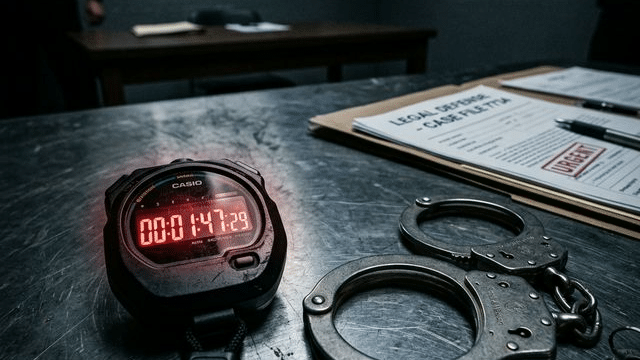
The speed of your criminal case largely depends on the experience and aggression of your legal representation. A public defender with a massive caseload may let your case sit stagnant for months. Private representation forces the prosecutor to the negotiation table immediately.
Are you stuck in legal limbo? At the Wolfgram Law Firm, we proactively push cases forward, filing aggressive pre-trial motions to force the prosecutor’s hand to secure early dismissals. Contact our Minneapolis defense team today for a free consultation. Stop waiting, and start fighting back.
Our Reviews

Client
Testimonials
 Wolfgram Law Firm Criminal Defense

Canadian Pacific Plaza, 120 South 6th St UNIT 2305, Minneapolis
-
They are truly the **best law firm ever**. From the moment I reached out, I was impressed by their professionalism and dedication. Every member of their team is **highly skilled** and knowledgeable, ensuring that I received the best possible guidance throughout my case.
What stood out the most was their commitment to achieving **the best outcomes** for their clients. They took the time to explain every step of the process, making me feel confident and well-informed. I am nothing but happy with my … More decision to choose this law firm.
If you’re looking for a **high-quality legal team** that truly cares about their clients, look no further than Wolfgram Law Firm. Thank you for everything you’ve done for me!


Our Location
Canadian Pacific Plaza, 120 South 6th Street, Suite 2305, Minneapolis, Minnesota 55402, United States


Call Us
612-584-3675 Hours: 9am - 5pm | Monday - Friday